IT resilience is no longer a nice-to-have—it’s a business-critical requirement. Yet one question comes up time and again in our conversations with IT decision-makers:
“Where do we even start?”
The short answer: Not with a single tool.
The right answer: With a structured, strategic approach.
That’s exactly why DARZ developed a clear BCM roadmap—a systematic framework that guides organizations from risk assessment through to a fully resilient disaster recovery and business continuity strategy.
What Is IT Resilience?
IT resilience is an organization’s ability to withstand IT disruptions and restore business operations quickly and effectively.
It includes:
The goal: Minimize downtime and keep risks under control.
Why Many BCM Strategies Fail in Practice
Many organizations have backups and disaster recovery plans in place, yet still struggle when an actual incident occurs due to:
- High infrastructure and standby costs
- Limited automation
- Manual recovery processes
- A lack of operational coordination during a crisis
DARZ combines technical resilience with cost efficiency and hands-on operational support.
Why Backup Alone Isn’t Enough
Traditional backups protect your data—but they don’t protect your business operations.
Common challenges without a comprehensive BCM strategy include:
- Undefined recovery objectives (RTO/RPO)
- Missing emergency procedures
- Untested recovery scenarios
- Dependency on individual team members
The result: When an incident occurs, organizations face chaos instead of control.
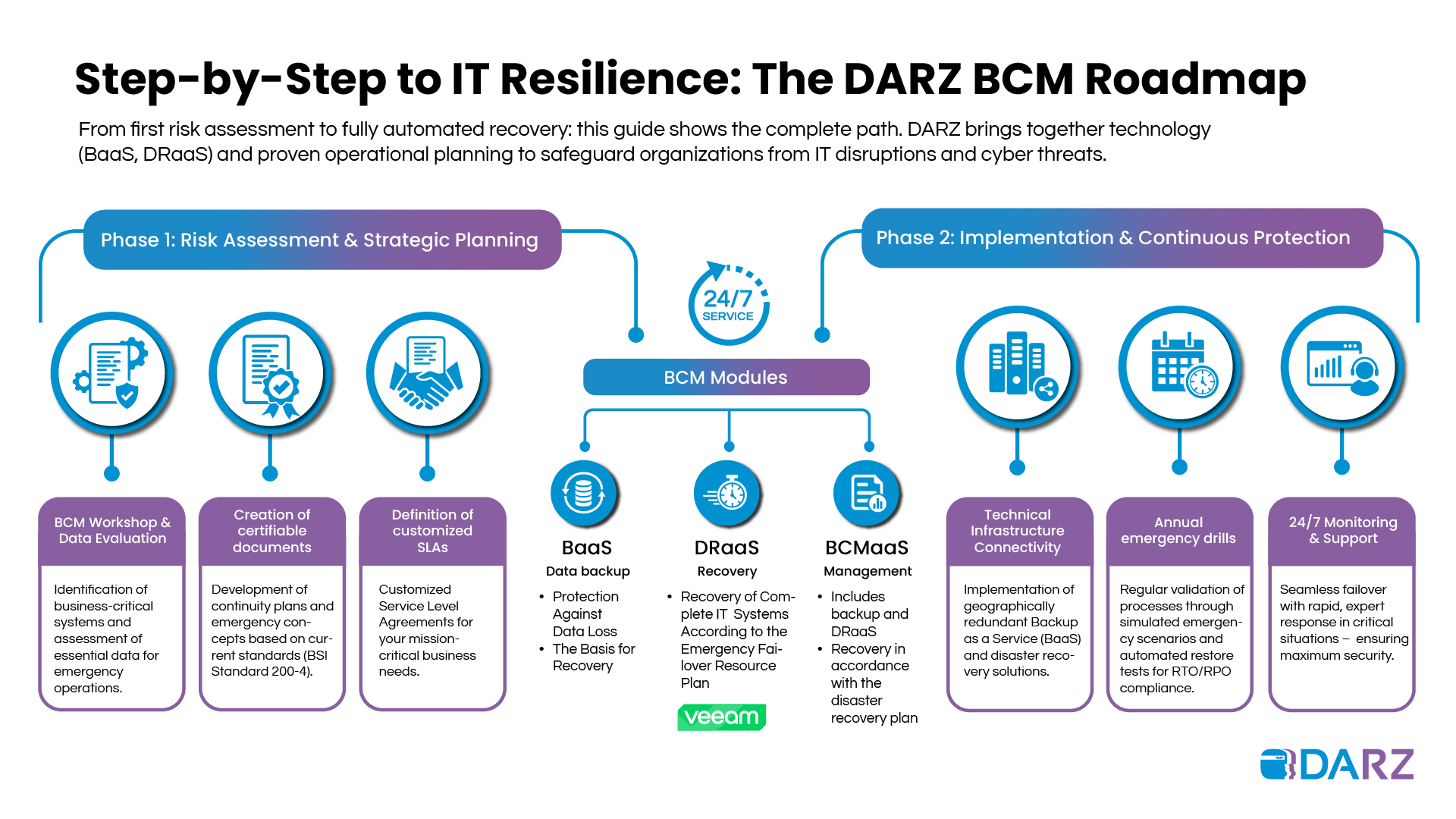
The DARZ BCM Roadmap
A structured BCM strategy consists of two key phases:
Phase 1: Assessment & Strategic Planning
This phase establishes the foundation for your organization’s IT resilience.
Objectives of the assessment phase:
- Identify business-critical systems
- Perform risk and business impact analyses
- Develop disaster recovery and business continuity strategies
- Define organization-specific Service Level Agreements (SLAs)
Implementation follows the BSI Standard 200-4 framework.
Outcome: A robust resilience strategy with clearly defined priorities and recovery plans.
Phase 2: Implementation & Continuous Protection
In this phase, the strategy is implemented and continuously maintained.
Key Building Blocks of Modern IT Resilience
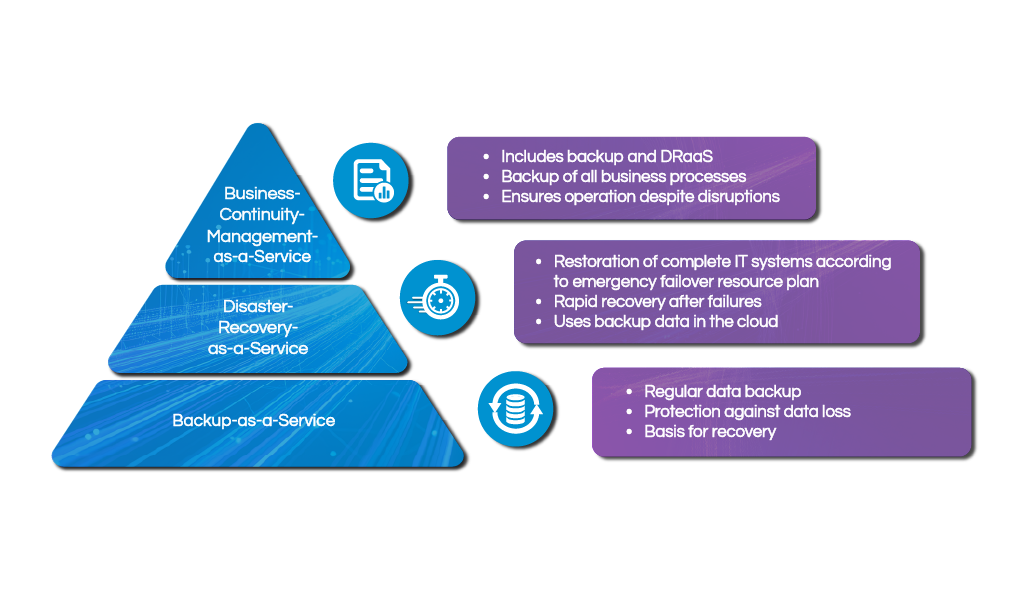
1. Backup as a Service (BaaS)
Reliable data protection as the foundation of every resilience strategy.
2. Disaster Recovery as a Service (DRaaS)
Rapid recovery of complete IT systems in line with defined RTO and RPO objectives.
3. Business Continuity Management as a Service (BCMaaS)
- Geographically redundant data protection
- Automated failover processes
- Emergency resource planning
- No ongoing costs for unused standby infrastructure—resources are billed only when disaster recovery is activated
4. Integration & Automation
- Integration with solutions such as Veeam
- Automated recovery workflows
- Continuous replication of critical BCM metadata (e.g., Active Directory, VPN configurations, network settings, and backup mappings) to the disaster recovery environment
5. Regular Disaster Recovery Testing
Realistic recovery simulations ensure your systems remain fully operational when it matters most.
6. 24/7 Expert Support
- Fast response and coordinated recovery during critical incidents
- Optional operational BCM management by DARZ—from incident assessment through coordination of the entire recovery process
Outcome: A fully tested, validated, and operational business continuity solution.
From BCM Strategy to Business Continuity in Action:
The Key Benefits of DARZ BCMaaS
DARZ’s structured BCM roadmap puts business-critical IT resilience at the center of your continuity strategy. While many traditional approaches are held back by high standby costs or manual recovery processes, DARZ combines technical resilience with operational efficiency and cost-effective service delivery.
1. Cost Efficiency: No Ongoing Standby Infrastructure Costs
One of the key advantages of the DARZ model is its cost-efficient approach to disaster recovery resources.
- Pay only when you need it: No ongoing costs for unused standby infrastructure.
- Usage-based pricing: Infrastructure costs are incurred only when disaster recovery is actually activated.
- Predictable costs: Managed services such as BCMaaS provide transparent, scalable pricing for organizations of any size.
2. Automation Instead of Manual Recovery
Manual recovery processes are often slow and error-prone during critical incidents. That’s why DARZ relies on automation wherever possible.
- Automated failover: Predefined failover processes enable rapid system recovery during a crisis.
- Continuous data replication: Critical BCM metadata—including Active Directory, VPN, network configurations, and backup mappings—is continuously replicated to the disaster recovery environment to ensure immediate availability.
- Continuous validation: Automated recovery testing and annual disaster recovery exercises verify that defined RTO and RPO objectives are consistently met.
3. Reduce Operational Burden with DARZ
To minimize dependence on individual employees, DARZ provides comprehensive operational support throughout the entire business continuity process.
- 24/7 expert support: A dedicated team is available around the clock to coordinate recovery efforts.
- Operational BCM management: If required, DARZ can take full operational responsibility during a crisis—from the initial situation assessment through the coordination of the complete recovery process.
- End-to-end guidance: Our BCM roadmap supports organizations from the initial risk assessment (based on BSI Standard 200-4) through to a fully automated disaster recovery solution.
Conclusion: IT Resilience Can Be Planned
IT resilience doesn’t happen by chance. It is the result of a structured, tested, and continuously optimized approach. A clearly defined BCM roadmap helps organizations to:
- Minimize risk
- Reduce downtime
- Ensure business continuity
Have questions? We’d be happy to help.
How Do I Get Started with Business Continuity Management?
Start with a risk assessment and business impact analysis (BIA). Based on the results, develop your business continuity and disaster recovery strategies, then implement the necessary technical measures.
How Do I Get Started with Business Continuity Management?
Start with a risk assessment and business impact analysis (BIA). Based on the results, develop your business continuity and disaster recovery strategies, then implement the necessary technical measures.
How Much Does a BCM Solution Cost?
The cost depends on factors such as your organization’s size, IT complexity, and required recovery objectives (RTO/RPO). Managed services such as BCMaaS provide predictable and scalable pricing.
How Often Should Disaster Recovery Tests Be Performed?
At least once a year. However, regular and automated testing is considered best practice to ensure ongoing readiness.
How Often Should Disaster Recovery Tests Be Performed?
At least once a year. However, regular and automated testing is considered best practice to ensure ongoing readiness.
What Do RTO and RPO Mean?
These two metrics are fundamental to every Business Continuity Management strategy:
- RTO (Recovery Time Objective): The maximum acceptable amount of time a system can be unavailable after an outage.
- RPO (Recovery Point Objective): The maximum acceptable amount of data loss, measured as the time between the last recoverable backup and the disruption.
Strong IT resilience means both objectives are clearly defined, realistic, and regularly tested.
Further Information
Learn more about the DARZ BCMaaS approach here.